

Recommendations
Project 3: Recommendations on the show planner
The recommendations are one of the most used features at the shows, it helps driving exposure to both Exhibitors and visitors based on behavior and data, providing a more complete experience. However, recommendations alone are not enough as the user needs to be able to mark somehow who is he/she interested in and would like to connect with later on.
This project focuses on creating the Matchmaking component more interactive by enabling the user to 'like' or unlike' each card recommended to the user. When a recommendation is liked it gets saved on the show planner to help the user manage a list of potential visits when during the show. the latter feature is the 6th most used component of the site and improving its functionality can increase customer retention as it builds trust among both users Exhibitors and visitors
User: Visitor
Requirement 1: Enable interaction like / unlike
Requirement 2: Provide other interactive features to improve the event planning experience and increase activity through the matchmaking components, user retention, and conversion.
The process
Discovery
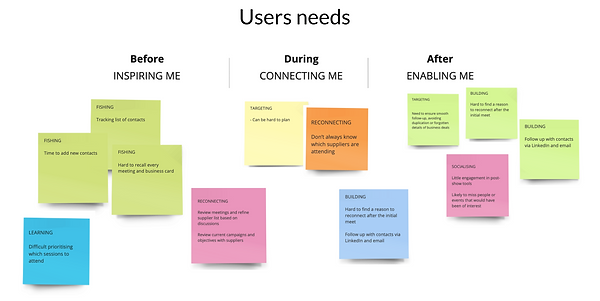
Resource 1: Reeds is an international company, and wants to ensure we define an experience that can be implemented across all countries I needed to ensure the business units were aligned. this allowed me to understand What / Why and How they operate their mindset and how things operate for each country.
Resource 2: The 'Visitor's journey', done by the company a few years back, I wanted to map out what feature would be crucial and in which stage of the journey.
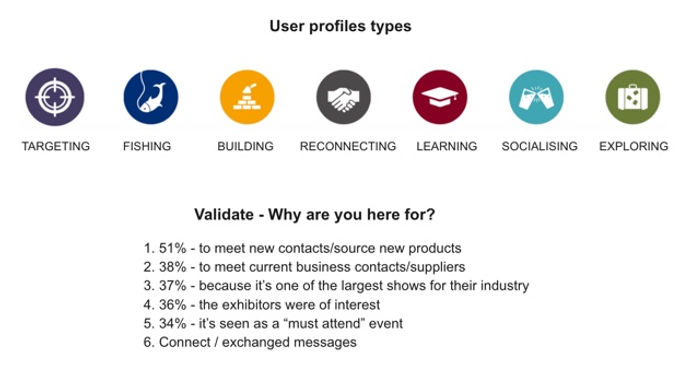
Resource 3: A research is done on the 7 behaviors, this gave me an understanding of the types of personalities we have at the shows and KPIs indicators
Resource 4: A training on gamification training was done to understand what motivates these behaviors to interact with our component and service in a given stage of the event's journey.



Challenges
- Poor guidance and communication between teams regarding research done years back or knowledge shared
- Lack of clarity on the requirements
- Information was given close to the deadline
- Lots of politics regarding the site space allocated to the teams
- Realized that we have a huge dependency on testing/research agencies
- The user's panel was small therefore the demographics didn't cover enough to give us a confirmation of our assumptions
- Data protection
- Technology constraints
- BUs promotion and adoption of features
Opportunities
- Established and an internal guerrilla testing process in place but did not get happen due to the current situation
- The research team experimented new ways of testing our work
- Lots of insides from the users through the testing session
- Lead to customization journeys
Learnings
After 2 months of discussions, presentations, and feedback loops. During one of my presentions to other POs and team, I learned that one of my PO knew about research done by an external agency for the same task but most likely did not remember as I was asked to do the same work again.
The positive of this is that all the findings I learned, and the solution I had in mind were already proposed on the research done by an external agency a year back. I clarify my deck was not as detailed and as pretty as the agency, but I was happy I was aligned to a similar outcome.
Mapping user journeys
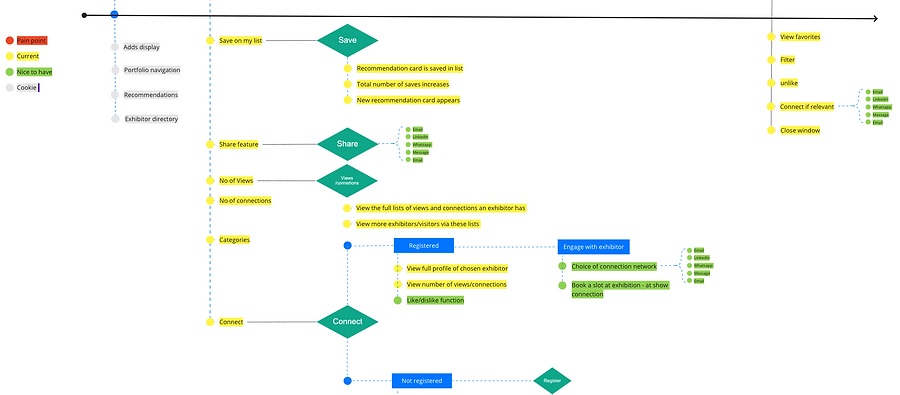
Based on my research, I listed the phases of the users' journey and the activities that would motivate and help the user achieve their objective effortless as shown in the image below.
Mapping actions and stages
Based on my research, I listed the phases of the users' journey and the activities that would motivate and help the user achieve their objective effortless as shown in the image below.


